



 AnyBody 应用案例
AnyBody 中代谢能量的计算
概要
AnyBody 软件中有一个名为Pmet的输出项,该数值代表肌肉的代谢功率,单位为焦耳 / 秒(J/s)。
我们将每个时刻全身所有肌肉的代谢功率 Pmet 进行累加,从第 n 步的数值 Pmet (n) 出发,计算出 dt 秒内的做功量 Q = Pmet (n) × dt,再对整个分析过程结束前的所有做功量求和,最终就能得到该动作所消耗的代谢能量,单位为焦耳(J)。如果动作具有周期性,只需分析一个周期内的运动,即可推算出持续运动时的代谢能量。
下文将以一个步态周期(右脚跟触地至下一次右脚跟触地)为对象进行分析,计算其代谢能量。
【分析模型与条件】
●模型:男性(身高 1.75 米,体重 66 千克)
●运动数据:采用 VICON 运动捕捉系统采集的自然步行动作
●地面反力:使用 AnyBody 自带的反力估算功能计算
●肌肉模型:上下肢肌肉均采用希尔(Hill)肌肉模型
●代谢计算:Pmet 的计算采用昂伯格(Umberger)肌肉代谢模型※
※ 引用文献Brian R. Umberger (2010) “Stance and swing phase costs in human walking” J. R.Soc. Interface 7, 1329–1340。
【分析结果】
图 1 展示了通过 AnyBody 分析得到的运动动画结果。

图 2 呈现了骨盆在行进方向上的位移随时间的变化关系。一个完整的步行周期耗时 1.23 秒,此期间骨盆在行进方向的位移为 1.47 米,平均移动速度约为 1.2 米 / 秒。
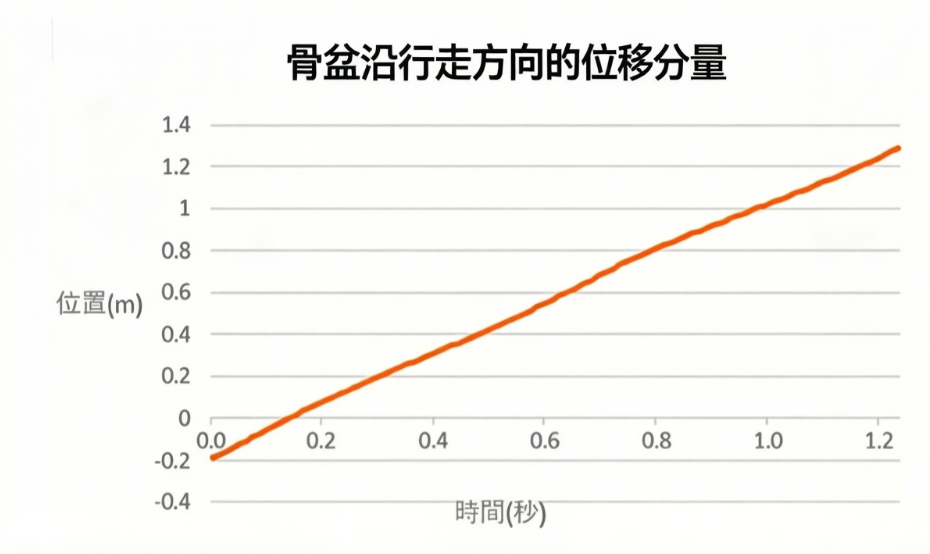
图 3 为肌肉代谢能量的相关数据。通过累计值计算,一个步态周期的能量消耗为 303 焦耳。
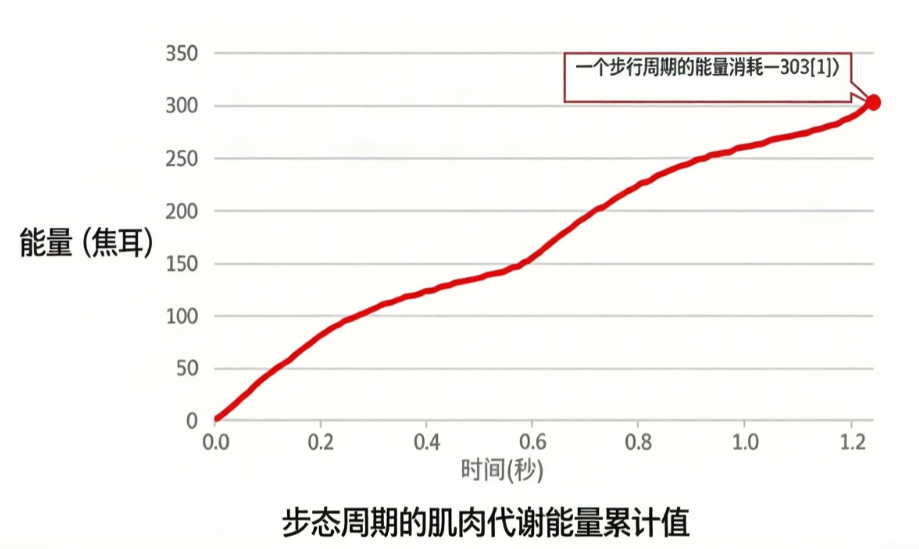
据此估算,若以相同步速持续步行 30 分钟,总能量消耗为:
303 [J]×60/1.23×30 = 443,414.63 [J]
在下一章节中,我们将通过代谢当量(METs)验证该分析结果的合理性。
基于代谢当量(METs)的能量消耗计算
METs(代谢当量)是代谢当量(Metabolic equivalent)的复数形式,是衡量身体活动(运动)强度的单位。它表示某一动作消耗的能量是安静状态下能量消耗的倍数,METs 数值越大,代表运动量越高。
计算公式:
METs(代谢当量)= 运动时代谢率(M) / 静息代谢率(RMR)
其基准值为静坐状态(安静坐姿)的代谢量,无论性别、体重,均以安静时的需氧量 3.5 毫升 / 千克 / 分钟 为计算标准;行业通用假设为:每升氧气消耗释放的热量为 5 千卡。
1 MET 对应的能量消耗计算:
3.5 [mL/(kg・min)] × 5 [kcal/L] × 60 [min/h] = 1.05 [kcal/(kg・h)]]
即:1 MET = 1.05 千卡 /(千克・小时)
步行速度与耗氧量(VO₂)存在相关性,平地步行的耗氧量可通过以下公式估算(速度单位:米 / 分钟):
VO₂ = 速度 (米 / 分钟)×0.1 + 3.5
式中:VO₂单位为 毫升 / 千克 / 分钟,通过该公式可进一步计算步行的能量消耗。
本次分析的步行数据平均值为 1.2 米 / 秒,换算为每分钟则是 72 米 / 分钟,因此:
VO₂ = 72 (米 / 分钟)×0.1 + 3.5 = 10.7
将该数值换算为 METs,结果为 10.7÷3.5 = 3.057。
日本国立研究研发法人医疗基础・健康・营养研究所官网刊载的资料《修订版 “身体活动的 METs 表”》(2012 年 4 月 11 日修订)中,记录了各类动作的 METs 值(网址:https://www.nibiohn.go.jp/eiken/programs/2011mets.pdf)。
本次步行动作(72 米 / 分钟,4.32 公里 / 小时)与之接近的是,该资料第 40 页记载:步行:4.0 公里 / 小时,平坦坚硬地面时的 METs 值为3,与上述数值基本一致。
体重 66 千克的人以 3METs 的强度步行 30 分钟,根据 METs 计算的能量消耗为 103.95 千卡。
计算公式:
66 [Kg]×1.05 [kcal/(kg・小时)]×0.5 [小时]×3 [METs] = 103.95 [kcal]
如前所述,AnyBody 分析得出的代谢能量为 443,414.63 焦耳。根据换算关系 4.184 焦耳 = 1 卡路里,该数值换算为千卡后为 105.98 千卡,与 METs 计算结果 103.95 千卡基本一致,验证了分析结果的合理性。
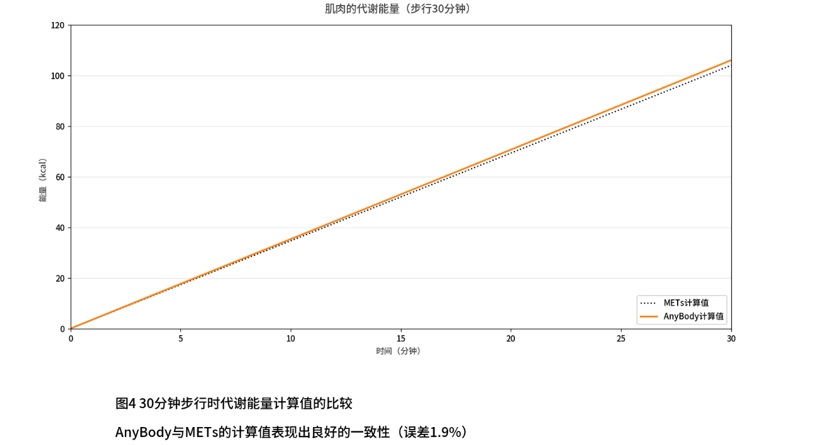
从过往的分析经验可以确认,AnyBody 能够对步行动作的能量消耗进行准确计算。借助该软件,我们可以对比不同动作的代谢能量,判断动作的效率;也可以通过代谢能量反推人体的耗氧量。
相关论文
1.论文:《基于新型骨骼肌肉建模系统的分析:整体矢状面对线不良与髋关节接触力增大的关联》
“Association between global sagittal malalignment and increasing hip joint contact force, analyzed by a novel musculoskeletal modeling system” #OpenAccess
Takanori Miura, Naohisa Miyakoshi, Kimio Saito, Hiroaki Kijima, Jumpei Iida, Kazutoshi Hatakeyama, Kotaro Suzuki, Akira Komatsu, Takehiro Iwami, Tosiki Matsunaga, Yoichi Shimada. Department of Orthopedic Surgery, Akita University Graduate School of Medicine, Akita, Japan.
https://pubmed.ncbi.nlm.nih.gov/34710144/
https://doi.org/10.1371/journal.pone.0259049
2.网络研讨会:《为分析下肢关节负荷而开展的受试者特异性股骨扭转建模研究》
”Modeling subject-specific femoral torsion for the analysis of lower-limb joint loads”
Dr. Enrico De Pieri , Research Associate at the University of Basel Children’s Hospital
https://www.frontiersin.org/articles/10.3389/fbioe.2021.679360/full
https://www.anybodytech.com/events/?fbclid=IwAR1QXU7-NJF6mhAUvIdYzM-DIOa92YtKu0i0f422zXN2gcHehQF747e41LE
3.论文:《站立宽度和脚尖朝向对负重深蹲过程中膝关节内侧接触力的影响作用》
”Influence of stance width and toe direction on medial knee contact force during bodyweight squats”
Akihiro Asayama、a) ,Hiroshige Tateuchi a), Momoko Yamagata a)b)c), Noriaki Ichihashi a)
a)Human Health Sciences, Graduate School of Medicine, Kyoto University, Japan
b)Department of Human Development, Graduate School of Human Development and Environment, Kobe University, Japan
c)Research Fellow of Japan Society for the Promotion of Science Kojimachi Business Center Building, Japan
https://www.sciencedirect.com/science/article/abs/pii/S0021929021005844?via%3Dihub
4.论文:《基于解剖学的全膝关节置换术动力学模型》
”An anatomy-based dynamic model of total knee arthroplasty”
Ehsan Askari a) , Michael S. Andersen b)
a)Department of Electromechanical, Systems and Metal Engineering, Ghent University, 9052, Zwijnaarde, Belgium
b)Department of Materials and Production, Aalborg University, 9220, Aalborg, Denmark
https://link.springer.com/article/10.1007%2Fs11071-021-06949-4
5.论文:《微创脊柱手术与传统术式在抬举作业中应用效果的生物力学对比评估》
”Biomechanical Evaluation of the Effect of Minimally Invasive Spine Surgery Compared with Traditional Approaches in Lifting Tasks”
John Rasmussen 1)*, www.frontiersin.orgKristoffer Iversen 2), www.frontiersin.orgBjørn Keller Engelund 2) and www.frontiersin.orgSten Rasmussen 3)
1) Department of Materials and Production, Aalborg University, Aalborg, Denmark
2) AnyBody Technology A/S, Aalborg, Denmark
3) Department of Clinical Medicine, Aalborg University and Aalborg University Hospital, Aalborg, Denmark.
https://conta.cc/3lO1jTW